Although not Bristol-designed aircraft, two new arrivals in the UK are worthy of mention here, for reasons explained below.
In June this year, two flying reproduction First World War aircraft were unloaded at Old Warden in Bedfordshire. These were B.E.2 aircraft, built by TVAL in New Zealand. Both are due to be based at Stow Maries, have been kept at Old Warden until hangar space is available. They are due to relocate in mid-August. They are painted to represent B.E.2s built in 1917: A2767 (actual registration ZK-KOZ) is painted in 37 Squadron RFC colours, which was based at Stow Maries in 1917. The other (actual registration ZK-TFZ) is in 7 Squadron markings as A2943. It is hoped the the former will remain at Stow Maries, and the latter, which is owned by Oliver Wulff, a German collector, will eventually go to Germany, but will stay at Stow Maries until 2018.
The Bristol connection comes from the aircraft they represent. Although designed by Geoffrey de Havilland of the Royal Aircraft Factory at Farnborough, production of the B.E.2 was assigned to several factories in the UK. The British & Colonial Aeroplane Company at Filton built over 1,000 of the type, more than any other factory. The original A2767 was delivered from Filton to 37 Squadron in February 1917, and A2943 was dispatched to France the following month.
More information on Stow Maries here, and the WW1 Aviation Heritage Trust here.
Wednesday, August 06, 2014
Hendon M1C moves to Cosford
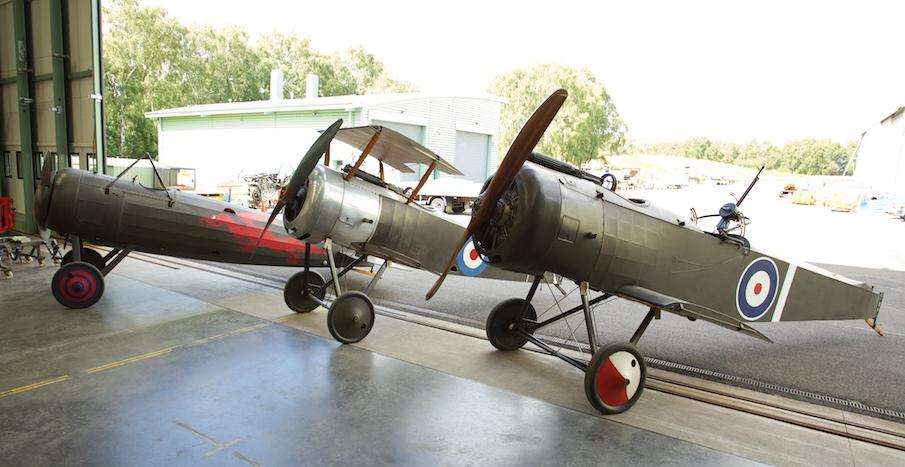 |
| The Bristol M1C, behind the two Sopwiths, at Cosford (RAF Museum) |
The RAF Museum's Bristol M1C monoplane has recently moved from Hendon to Cosford, to be part of the a new First World War exhibition. The M1C, along with the Museum's Sopwith 1½ Strutter and Sopwith Pup, arrived at Cosford on 15 July 2014. The exhibition, entitled 'First World War In The Air', will open in December 2014. More information on Cosford can be found here.
Wednesday, May 21, 2014
Beaufort restoration progress at Australian National Aviation Museum
The project to restore the oldest surviving Bristol Beaufort, A9-13, for the Australian National Aviation Museum has reached its fund-raising target for the first stage, but is still accepting pledges for the next steps. The Australian Aircraft Restoration Group (AARG) has been using Kickstarter to raise funds to restore the stern frame, with an initial target of 5000AUD, which was reached 10 days before the fund-raising deadline. However, the Kickstarter campaign is still running, and additional funds will go towards the next step, which is to restore the turret.
AARG acquired the partially restored Beaufort in 2011, for restoration and eventual display in the Australian National Aviation Museum at Moorabbin in Melbourne. Prior to that, the fuselage had been held by the Flypast Museum of Australian Army Flying at Oakey in Queensland. The Museum also has a Bristol Sycamore and Freighter, and one of the best preserved Bristol Beaufighters in the world.
A9-13 was one of 180 Beauforts destined for the Royal Air Force in Singapore. Although allocated RAF serial T9552, the order was cancelled in the early stages, and it rolled off the production line as A9-13 for the RAAF. It was delivered in January 1942, and served with 6 Squadron with code FX-F. It crashed on landing at Tadji in Papua New Guinea in 1945, while transporting fruit and vegetables, the cockpit and wings being damaged by fire in the accident. The remains were recovered from Tadji in the 1970's, and moved initially to Auckland, New Zealand, then Melbourne, Australia. Restoration commenced in 1977 by Monty Armstrong, and includes the forward fuselage from Beaufort A9-210, recovered from Tadji at the same time.
Regular progress reports are posted on the Key Publishing Historic Aviation (i.e. Flypast) Forum.
The Kickstarter page can be found here: https://www.kickstarter.com/projects/moorabbinairmuseum/raaf-beaufort-a9-13-restoration
A9-13 was one of 180 Beauforts destined for the Royal Air Force in Singapore. Although allocated RAF serial T9552, the order was cancelled in the early stages, and it rolled off the production line as A9-13 for the RAAF. It was delivered in January 1942, and served with 6 Squadron with code FX-F. It crashed on landing at Tadji in Papua New Guinea in 1945, while transporting fruit and vegetables, the cockpit and wings being damaged by fire in the accident. The remains were recovered from Tadji in the 1970's, and moved initially to Auckland, New Zealand, then Melbourne, Australia. Restoration commenced in 1977 by Monty Armstrong, and includes the forward fuselage from Beaufort A9-210, recovered from Tadji at the same time.
Regular progress reports are posted on the Key Publishing Historic Aviation (i.e. Flypast) Forum.
The Kickstarter page can be found here: https://www.kickstarter.com/projects/moorabbinairmuseum/raaf-beaufort-a9-13-restoration
Wednesday, March 12, 2014
Bristol Boxkite celebrates RAAF centenary
The Royal Australian Air Force has celebrated its centenary by flying a reproduction Bristol Boxkite exactly 100 years after a Bristol Boxkite made the first military flight in Australia. The event took place during at air show over the weekend of 1st and 2nd of March at Point Cook in Victoria, the same location where original flight took place. The flight was the culmination of several years of work to build the Boxkite, to the original design using authentic materials. The Boxkite is fitted with a locally-built 110 h.p. Rotec R2800 radial engine, instead of a Gnome rotary engine, and visually fits in with the period. When the project started in 2006, working rotary engines were extremely rare, and the Rotec is much more reliable.
To mark the occasion, the project has produced a book covering the conception, design and construction of the Boxkite, along with original news accounts and photographs, and is a must for all Boxkite-lovers. The book can be shipped worldwide, and more details are available on the project website. The project also has its own Facebook page.
Sunday, January 19, 2014
Moorabbin Sycamore engine run
The engine of Bristol Sycamore Mk.3 A91-1 has been run for the first time in around 25 years. The helicopter is with the Moorabin Air Museum in Melbourne, Australia. The helicopter was acquired by the museum in 1967, after it was wrecked in an accident. It has been fully restored, and the video shows the Alvis Leonides engine being turned over in January 2014.
The Sycamore was delivered to the Royal Australian Air Force in 1951 in the hold of a Bristol Freighter. It was disposed of in 1965, and operated as a heavy lifting vehicle as VH-GYR in Victoria until its accident. The museum's Bristol Freighter has also been undergoing some TLC, including the fitting of its flying surfaces. More information can be found on their Facebook page.
The Sycamore was delivered to the Royal Australian Air Force in 1951 in the hold of a Bristol Freighter. It was disposed of in 1965, and operated as a heavy lifting vehicle as VH-GYR in Victoria until its accident. The museum's Bristol Freighter has also been undergoing some TLC, including the fitting of its flying surfaces. More information can be found on their Facebook page.
Tuesday, December 31, 2013
Britannia prototype presented to Bristol Aero Collection
On 23rd December 1953, the second prototype Bristol Britannia took off from Filton's runway. Just over a month later, on 4th February 1954, G-ALRX belly-landed on the Severn Estuary mudflats after a dramatic in-flight engine fire. Thanks to the skills of test pilot Bill Pegg, none of the thirteen people on-board were hurt, however the aircraft's reputation was little bruised by the impromtu landing. 'RX was damaged beyond repair when the tide came in, but the forward fuselage section lived on as an instructional aid until 1995, when it was acquired for preservation by the Britannia Aircraft Preservation Trust and loaned to the Bristol Aero Collection Trust.
 |
| Britannia G-ALRX during dismantling on the Severn mudflats. |
On 23rd December 2013, exactly sixty years since its first flight, ownership of the Britannia was transferred to the Bristol Aero Collection in a ceremony at Filton, when the Collection is in store. The Britannia is now guaranteed a future in the Bristol Aerospace Centre, the planned museum at Filton, which will open in a few years time.
 |
| Roger Hargreaves (left), chairman of the Britannia Aircraft Preservation Trust, hands over Britannia G-ALRX to Oliver Dearden (right) of the Bristol Aero Collection Trust. |
Friday, November 29, 2013
Bristol Aircraft in 2013
The biggest news item of the year has been the go-ahead for a new museum and learning centre at Filton, the spiritual home of Bristol aircraft. Named the Bristol Aerospace Centre, it will tell the story of the history of aviation and aerospace on the site. Centrepiece will of course be Concorde 216, which made the last Concorde flight when it flew into Filton in 2003. In addition to Concorde, the centre will house the contents of the former Bristol Aero Collection museum at Kemble, which went into storage in 2012 and is now housed in the Brabazon Hall at Filton. New additions to the Collection this year have been the reproduction Bristol Fighter built by employees of Airbus, Rolls-Royce and GKN in 2010, and the (unofficial) last aircraft to be built at Filton: the Whitakker MW4 microlight.
2013 has also been a significant year for a number of individual Bristol aircraft. The world's last airworthy Sycamore helicopter made it's first flight after several years of storage and a major overhaul. Now registered OE-SXY, the Flying Bulls team at Salsburg in Austria have done a great job bringing it back to flight. The Sycamore made its return to flight in July, flown by top aerobatic helicopter pilot Sigi 'Blacky' Schwarz.
Another significant first this year was made on 11 September at Point Cook in Australia, when reproduction Bristol Boxkite VH-XKT took to the air for the first time. This doubles the number of airworthy Boxkites, the other being the Shuttleworths reproduction built in 1965. The Australian Boxkite has a number of differences from the Shuttleworth example, the most obvious being the upper wing extensions that became standard on most Boxkites from 1911. It also does not have the central vertical tail surface the was added to the Shuttleworth Boxkite during filming of Those Magnificent Men... More details of the build and flight can be found on the Boxkite 2014 website.
The rebuild of the sole airworthy Bristol Blenheim (actually a Canadian-built Bolingbroke) achieved a visual landmark moment when it was rolled out in camouflage at Duxford in August. The restored Bristol Mercury engines had not yet been fitted, but the airframe itself now is very close to completion. The long-nose Blenheim Mk.IV (G-BPIV) suffered damage from a landing accident in August 2003, and the opportunity has been taken to rebuild the aircraft as a Mk.I, replacing the 'long nose' with a 'short nose' which had been converted to a car in the 1940s. More details on the Blenheim Society website.
Also worthy of mention is the Bristol Scout project currently underway by Rick and David Bremner in the Shropshire. Regular updates can be found on their blog. Great progress has been made in 2013, with the airframe itself complete and just the fitting of equipment and fabric covering to go.
 |
| Some of the Bristol Aero Collection exhibits in store at Filton. |
2013 has also been a significant year for a number of individual Bristol aircraft. The world's last airworthy Sycamore helicopter made it's first flight after several years of storage and a major overhaul. Now registered OE-SXY, the Flying Bulls team at Salsburg in Austria have done a great job bringing it back to flight. The Sycamore made its return to flight in July, flown by top aerobatic helicopter pilot Sigi 'Blacky' Schwarz.
 |
| Bristol Sycamore OE-XSY in flight at Salsburg |
Another significant first this year was made on 11 September at Point Cook in Australia, when reproduction Bristol Boxkite VH-XKT took to the air for the first time. This doubles the number of airworthy Boxkites, the other being the Shuttleworths reproduction built in 1965. The Australian Boxkite has a number of differences from the Shuttleworth example, the most obvious being the upper wing extensions that became standard on most Boxkites from 1911. It also does not have the central vertical tail surface the was added to the Shuttleworth Boxkite during filming of Those Magnificent Men... More details of the build and flight can be found on the Boxkite 2014 website.
 |
| Bristol Boxkite VH-XKT on its first flight at Point Cook |
The rebuild of the sole airworthy Bristol Blenheim (actually a Canadian-built Bolingbroke) achieved a visual landmark moment when it was rolled out in camouflage at Duxford in August. The restored Bristol Mercury engines had not yet been fitted, but the airframe itself now is very close to completion. The long-nose Blenheim Mk.IV (G-BPIV) suffered damage from a landing accident in August 2003, and the opportunity has been taken to rebuild the aircraft as a Mk.I, replacing the 'long nose' with a 'short nose' which had been converted to a car in the 1940s. More details on the Blenheim Society website.
Also worthy of mention is the Bristol Scout project currently underway by Rick and David Bremner in the Shropshire. Regular updates can be found on their blog. Great progress has been made in 2013, with the airframe itself complete and just the fitting of equipment and fabric covering to go.

Resurrection
After a break of a couple of years, I have decided to resuscitate this blog to report on the goings on in the world of Bristol aircraft. The blog was originally part of the Filton Airfield website that I ran from 2000 to 2011, which included a large section on surviving Bristol-designed and built aircraft around the world. with less and less spare time, and fewer goings on at Filton, the website was only occasionally updated, and when the host decided to cease business I decided to let fade away (although some of it can still be found using the Wayback Machine).
Filton Airfield may now be closed, but there is still plenty in the world of Bristol aircraft to write about, so with a bit more spare time and the prospect of a book that will include much of the information from the old website, the blog have been revived!
Filton Airfield may now be closed, but there is still plenty in the world of Bristol aircraft to write about, so with a bit more spare time and the prospect of a book that will include much of the information from the old website, the blog have been revived!
Wednesday, April 06, 2011
Beaufighter project sold in Australia
Tim Moore (Skysport Engineering) has reportedly sold his Bristol Beaufighter project in Australia, and it is expected that it will be shipped there during 2011. The project is a substantial collection of Beaufighter parts, based on a Old Mixon-built Mark IF fuselage and centre wing section (serial X7688), which had been used by No.1 School of Technical Training at RAF Halton as a instructional airframe. From the early 1950s through to 1971 the aircraft, which was attached to a brick hut, was used to train apprentices on engine start up and running procedures. Prior to this, the Beaufighter was an engine test bed at Filton, and it retained its unique four-propeller Hercules 130 configuration during its years at Halton. Tim had also acquired the rear fuselage of an Australian Beuafighter (serial A19-148). At this stage it is not known who has bought the project or what their intensions are, but it is well known that Tim was very keen for the aircraft to fly one day. One considerable stumbling block (as with the Duxford Beaufighter project) is sourcing suitable Hercules engines.
Plans to restore Sycamore to fly
Plans have been unveiled to restore Bristol Sycamore HR Mk.52 HB-RXB to flight. For many years this helicopter was the last airworthy Sycamore in the world, and was owned and maintained by Peter Schmid at Altenrhein in Switerland. Having not flown for several years, this Sycamore has been puchased by The Flying Bulls and moved to their facility at Salzburg in Austria in November 2010, for a complete overhaul and return to flight. Although HB-RXB is a former West German Forces machine, it was flown in ‘mock’ 32 Squadron RAF colours as ‘XG 544’. Its new home in Austria is fitting as the Sycamore was designed by Austrian Raoul Hafner during his tenure at Bristols.
Brigand moves to Cosford
The remains of the sole surviving Brigand, RH746, left Kemble in May 2010 for the RAF Museum at Cosford. It had been in storage with the Bristol Aero Collection, as there was not enough room to display it following their move to a smaller area a few years ago. It is hoped that some restoration work can now take place.
Sunday, February 28, 2010
Bristol Bulldog comes home
 In a surprise move, The RAF Museums Bristol Bulldog appeared at the BAC 100 launch party at Filton on 19th February 2010. The event marked the start of a year of activities to celebrate 100 years of aircraft production at Filton. The launch took place in the east bay of the Brabazon Hangar, and included the naming of an Easyjet Airbus A.319 after Sir George White, founder of the Bristol Aeroplane Company. The Bulldog was the only Bristol aircraft, however there were several aircraft models, and other Bristol products - cars, buses and aero engines.
The Bulldog arrived at Filton a few days before the event, and was scheduled to return to Hendon soon after.
2009 updates
There were only a few movements in the Bristol Aircraft world to report in 2009. Keith Williams and Mike Thorn finished the restoration of their Bristol Scout replica, to a far higher standard than the 'original' airframe, built in 1962. It has gone on display with the Shuttleworth Trust at Old Warden in Bedfordshire, pending the planned museum at Filton.
Elsewhere, steady progress has been made on the restorations of Britannia 'Charlie Fox' in Liverpool, the Helicopter Museum Belvedere at Weston-super-Mare, and the Blenheim Society's recreation of a Mark I Blenheim.
Concorde-wise, G-BOAC at Manchester has gone under cover in its purpose-built 'hangar', and G-BOAD has returned to Manhattan following the major renovation of the Intrepid Museum in New York.
Elsewhere, steady progress has been made on the restorations of Britannia 'Charlie Fox' in Liverpool, the Helicopter Museum Belvedere at Weston-super-Mare, and the Blenheim Society's recreation of a Mark I Blenheim.
Concorde-wise, G-BOAC at Manchester has gone under cover in its purpose-built 'hangar', and G-BOAD has returned to Manhattan following the major renovation of the Intrepid Museum in New York.
Monday, June 16, 2008
Omaka Freighter comes back to life
Following the recent news that Alistair Marshall has been working on the Bristol Hercules engines of the Bristol Freighter at Omaka in New Zealand, the port engine successfully run up on 13th June 2008. The Starboard engine was briefly run a few days later. Click below for video of the event.
A high resolution version of this video is available at www.aviationfilm.com.
Monday, May 26, 2008
Mk.I nose trial fitted to Duxford Blenheim
A significant moment in the restoration of the Duxford Blenheim took place in May 2008, when the Blenheim Mk.I nose was trial-fitted to the Blenheim fuselage. The aircraft, which had represented a 'long nose' Mk.IV Blenheim since its first post-rebuild flight in 1993, was damaged in a landing accident in 2003. This gave the team the opportunity to incorporate the short nose of a Mk.I Blenheim in the repairs. Other major components such as the centre wing section, rear fuselage and outer wings had been restored and mated previously. The addition of the Mk.I nose gives a shape that has not been seen for many decades.

The Mk.I nose is still just a shell, and there is much work to do in fitting it out with equipment and cabling. It will be detached from the fuselage soon so the rebuild work can continue.
Saturday, May 24, 2008
Plans to bring Omaka Freighter back to life
A member of the Marlborough Aero Club at Omaka in New Zealand has started the huge task of bringing the clubs Bristol Freighter back to life. The aircraft, ZK-CPT, arrived at Omaka in 1986, and the engines were inhibited in the 1990's. The intention is to get the Bristol Hercules engines running, and it may even be possible to taxi the Freighter in the future. Progress is regularly reported on the
Wings Over New Zealand Aviation Forum.
Wings Over New Zealand Aviation Forum.
Thursday, February 21, 2008
Sycamore swap at Weston-super-Mare
The Helicopter Museum have recently acquired a VIP Sycamore HR.14, but have disposed of their existing Sycamore HC.14. The Sycamore HR.14, serial XJ829, had previously been not far away in the Bristol Industrial Museum, which has closed for major renovation. It was formerly with the RAF 32 VIP communications Squadron, and arrived on 17th October 2007, going on display on 12th January 2008. For details and photos of the delivery, see http://www.hmfriends.org.uk/sycamorexl829.htm.
The museum has taken the opportunity to exchange their existing Sycamore, XG547, with a type they don't have - an ex-Belgian Army Alouette II. A lowloader arrived at Weston-super-Mare with the Alouette on 19th February 2008, and returned to Belgium with the Sycamore on 21st. XG547 will go on display in the Royal Army and Military History Museum in Brussels in due course. The Belgian Army operated three Sycamores in the Belgian Congo, but none of these survive.
Wednesday, October 24, 2007
Beaufighter found in Aegean sea
The remains of a Bristol Beaufighter were discovered in June 2007, near the Greek island of Naxos. A team of divers had been searching for the wreck for over a year, following stories that a Beaufighter had ditched in the area during World War 2. It was discovered off the coast of Cape Kouroupas, to the west of Naxos, at a depth of 34 metres. The aircraft, identified as a Beaufighter TF.X serial JM225, was part of a flight attacking enemy ships in Naxos Harbour on 30th October 1943. It was hit by ground fire, and the two crew - F/O W.E.Hayter and W/O T.J.Harper, both New Zealanders - baled out before the aircraft hit the water. They were rescued by locals, treated and later smuggled off the island. JM255 was based in Cyprus with No.47 Squadron RAF.
The aircraft is on its belly and surprisingly intact, apart from a broken back. Some smaller items, such as the nosecone, are unattached and resting on the sea bed nearby. The propeller from the starboard engine is missing, so it may have come off when the Beaufighter hit the water. Naxos Diving Centre can arrange visits for experienced divers, see naxosdiving.com.
Thursday, July 12, 2007
Australian Boxkite replica for 2014 centenary
A small dedicated team in Australia have embarked on a project to build an airworthy Bristol Boxkite replica, in time for the centenary of the first military flight in Australia. On the morning of March 1st, 1914, Lieutenant Eric Harrison, an aviator instructor, took Bristol Military Biplane CFS-3 into the air at the newly acquired Army flying field at Point Cook, Victoria. This was the home of the Central Flying School (CFS). That historic flight is now recognised as the starting point of all military flying in Australia.
This Australian replica Boxkite will be built over a period of four to five years. This will ensure that the aeroplane is available in sufficient time to take part in celebrations that will occur in March 2014. With Project 2014 having started in 2006, ample time is available to allow for the resolution of unforeseen problems that may arise during the building of this machine, and the subsequent test flying.
 The first wing ribs under construction. Courtesy of Project 2014
The Project Manager, Ron Gretton AM, was the driving force behind the RAAF Museum’s Supermarine Walrus (HD874) restoration. Assistant Project Manager Geoff Matthews joined Ron on the Walrus restoration, and they are both highly experienced ex-RAAF engineering officers with a wealth of the skills required in this project. They are already well into the organisational phase and have already started to cut wood and form shapes for the ribs, booms and undercarriage. Many of the metal fittings have been cut, welded and plated.
The engine will be an Australian seven cylinder 110hp (82kw) radial Rotec R2800, designed and manufactured by Rotec Engineering Pty Ltd at Moorabbin, Victoria. Rosebank Engineering has kindly supplied the engine and all the timber for the project. Mobile Network has supplied the wheels and structural metal, and Aerostructures, and Macdonald Technologies International have also provided significant support. The project is, of course, supported by both the RAAF Museum and the Air Force itself.
Sunday, June 10, 2007
Restoration of Finnish Blenheim starts
Restoration work on Blenheim Mk.IV BL-200, the sole surviving 'true' Bristol Blenheim, has started in Finland. The aircraft has been in storage at Tikkakoski in Finland, but spent many decades on display at the main gate there and in other museums. Work started on 18th May 2007, with a paint strip and preparation work. On completion, the aircraft will be housed in a dedicated building at Keski-Suomen Ilmailumuseo (Aviation Museum of Central Finland).
55 Blenheim Mk.Is and IVs were assembled in Finland by Valtion Lentokonetehdas at Tampere, using many components from Yugoslavia. BL-200 was built in 1944, and flew on in peace time doing survey work. It was withdrawn in 1956, making it one of the last 'true' Blenheims to fly. Several present-day aircraft have been painted up or structurally modified to become Blenheims, but these are infact Canadian-built Fairchild Bolingbrokes, a licence built Blenheim with a few home-grown differences.
Blenheim BL-200 under restoration - www.k-silmailumuseo.fi

The restoration project has its own internet Blog to show progress. It is in Finnish, but still worth a look even if you don't know the language! - http://www.ilmasotakoulunkilta.fi/IlmaSK/ilmaskmma.nsf/sp?Open&cid=Content9993D
Subscribe to:
Posts (Atom)