OK, so it has been a while since the last post. Here is what has been going on in the past couple of years.
The Blenheim Mk.I made its first flight from Duxford on 20th November 2014. It has delighted crowds at air displays in 2015 and 2016, and it looks like 2017 will be another good year to see this outstanding aircraft.
Another incredible first flight took place on 9th July 2015, when David Bremner's Bristol Scout took to the air. This project is based around three original items: a stick, rudder bar and magneto. It is a very accurate reproduction of a Bristol Scout, based on original drawings and authentic materials. A TV film of the project is due soon.
TVAL in New Zealand have completed a couple of Bristol Fighters, one static example for the Muzeum Lotnictwa Polskiego in Krakow, Poland, and a flyer for Jean Salis at La Ferte Alais in France. The latter first flew on 26th July 2014. Its first flight in France on 6 April 2015, and now appears at air shows at La Ferte Alais.
This now means there are nine Bristol aircraft regularly flying :
One Boxkite (At Shuttleworth, another reproduction in Australia is capable of flight but no longer flies)
One Bristol Scout
Four Bristol Fighters (UK, France, New Zealand and Australia)
One Bristol M1C
One Blenheim Mk.I
One Sycamore (in Austria)
The Bristol Aero Collection's efforts to built a world-class museum at Filton have nearly come to fruition. Exhibits are being put in place in the WW1 hangar and purpose-built Concorde hangar. It will open Summer 2017, as Aerospace Bristol. Interest in the museum has generated some new exhibits including a Bristol Pegasus powered Sea Harrier and a second Bristol Sycamore helicopter. In addition to the Bolingbroke rebuild, several new projects are underway, including a Bristol Fighter based on an original frame (from the Weston-on-the-Green cache) and a Bristol 170 Freighter from New Zealand.
Wednesday, April 12, 2017

Thursday, November 20, 2014
Duxford Blenheim moves under its own power
Following several years of hard work, the Duxford Blenheim project achieved a significant milestone on 19th November, when the Blenheim Mk.I made its first taxy trials. In the setting sun, the Blenheim moved under its own power from the ARCo site out to the airfield and back. It has now been painted with a squadron code, YP-Q, which was the code carried by Blenheim Mk.I L6739 when it was with 23 Squadron in 1940. Although much of the material in the rebuild comes from the previously airworthy long-nose Bolingbroke, G-BPIV, the opportunity has been taken to graft on the shorter nose of a Mark I, which originally came from L6739. Blenheim L6739 was broken up shortly after the Second World War, but the nose was acquired by a Bristol Aeroplane Company employee and turned into a roadworthy car, using an Austin 7 chassis.
Photo from AJCDuxman on Flickr.
Photo from AJCDuxman on Flickr.
Wednesday, August 06, 2014
New B.E.2s in UK
Although not Bristol-designed aircraft, two new arrivals in the UK are worthy of mention here, for reasons explained below.
In June this year, two flying reproduction First World War aircraft were unloaded at Old Warden in Bedfordshire. These were B.E.2 aircraft, built by TVAL in New Zealand. Both are due to be based at Stow Maries, have been kept at Old Warden until hangar space is available. They are due to relocate in mid-August. They are painted to represent B.E.2s built in 1917: A2767 (actual registration ZK-KOZ) is painted in 37 Squadron RFC colours, which was based at Stow Maries in 1917. The other (actual registration ZK-TFZ) is in 7 Squadron markings as A2943. It is hoped the the former will remain at Stow Maries, and the latter, which is owned by Oliver Wulff, a German collector, will eventually go to Germany, but will stay at Stow Maries until 2018.
The Bristol connection comes from the aircraft they represent. Although designed by Geoffrey de Havilland of the Royal Aircraft Factory at Farnborough, production of the B.E.2 was assigned to several factories in the UK. The British & Colonial Aeroplane Company at Filton built over 1,000 of the type, more than any other factory. The original A2767 was delivered from Filton to 37 Squadron in February 1917, and A2943 was dispatched to France the following month.
More information on Stow Maries here, and the WW1 Aviation Heritage Trust here.
In June this year, two flying reproduction First World War aircraft were unloaded at Old Warden in Bedfordshire. These were B.E.2 aircraft, built by TVAL in New Zealand. Both are due to be based at Stow Maries, have been kept at Old Warden until hangar space is available. They are due to relocate in mid-August. They are painted to represent B.E.2s built in 1917: A2767 (actual registration ZK-KOZ) is painted in 37 Squadron RFC colours, which was based at Stow Maries in 1917. The other (actual registration ZK-TFZ) is in 7 Squadron markings as A2943. It is hoped the the former will remain at Stow Maries, and the latter, which is owned by Oliver Wulff, a German collector, will eventually go to Germany, but will stay at Stow Maries until 2018.
The Bristol connection comes from the aircraft they represent. Although designed by Geoffrey de Havilland of the Royal Aircraft Factory at Farnborough, production of the B.E.2 was assigned to several factories in the UK. The British & Colonial Aeroplane Company at Filton built over 1,000 of the type, more than any other factory. The original A2767 was delivered from Filton to 37 Squadron in February 1917, and A2943 was dispatched to France the following month.
More information on Stow Maries here, and the WW1 Aviation Heritage Trust here.
Hendon M1C moves to Cosford
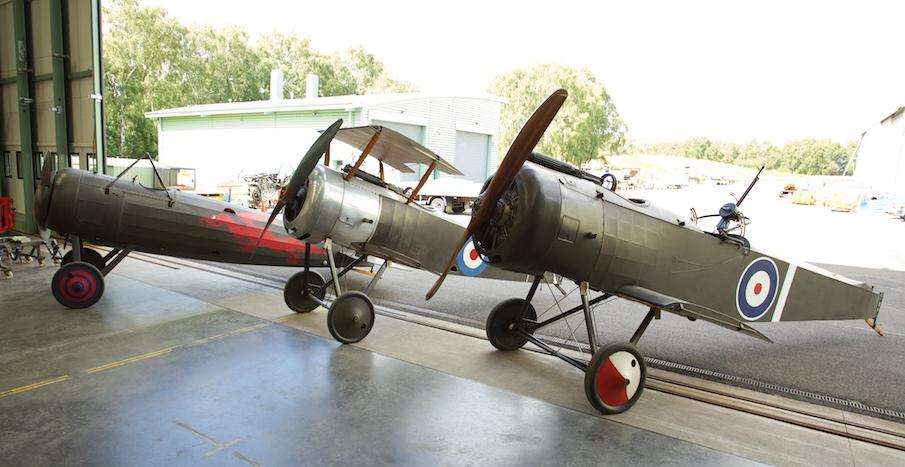 |
| The Bristol M1C, behind the two Sopwiths, at Cosford (RAF Museum) |
The RAF Museum's Bristol M1C monoplane has recently moved from Hendon to Cosford, to be part of the a new First World War exhibition. The M1C, along with the Museum's Sopwith 1½ Strutter and Sopwith Pup, arrived at Cosford on 15 July 2014. The exhibition, entitled 'First World War In The Air', will open in December 2014. More information on Cosford can be found here.
Wednesday, May 21, 2014
Beaufort restoration progress at Australian National Aviation Museum
The project to restore the oldest surviving Bristol Beaufort, A9-13, for the Australian National Aviation Museum has reached its fund-raising target for the first stage, but is still accepting pledges for the next steps. The Australian Aircraft Restoration Group (AARG) has been using Kickstarter to raise funds to restore the stern frame, with an initial target of 5000AUD, which was reached 10 days before the fund-raising deadline. However, the Kickstarter campaign is still running, and additional funds will go towards the next step, which is to restore the turret.
AARG acquired the partially restored Beaufort in 2011, for restoration and eventual display in the Australian National Aviation Museum at Moorabbin in Melbourne. Prior to that, the fuselage had been held by the Flypast Museum of Australian Army Flying at Oakey in Queensland. The Museum also has a Bristol Sycamore and Freighter, and one of the best preserved Bristol Beaufighters in the world.
A9-13 was one of 180 Beauforts destined for the Royal Air Force in Singapore. Although allocated RAF serial T9552, the order was cancelled in the early stages, and it rolled off the production line as A9-13 for the RAAF. It was delivered in January 1942, and served with 6 Squadron with code FX-F. It crashed on landing at Tadji in Papua New Guinea in 1945, while transporting fruit and vegetables, the cockpit and wings being damaged by fire in the accident. The remains were recovered from Tadji in the 1970's, and moved initially to Auckland, New Zealand, then Melbourne, Australia. Restoration commenced in 1977 by Monty Armstrong, and includes the forward fuselage from Beaufort A9-210, recovered from Tadji at the same time.
Regular progress reports are posted on the Key Publishing Historic Aviation (i.e. Flypast) Forum.
The Kickstarter page can be found here: https://www.kickstarter.com/projects/moorabbinairmuseum/raaf-beaufort-a9-13-restoration
A9-13 was one of 180 Beauforts destined for the Royal Air Force in Singapore. Although allocated RAF serial T9552, the order was cancelled in the early stages, and it rolled off the production line as A9-13 for the RAAF. It was delivered in January 1942, and served with 6 Squadron with code FX-F. It crashed on landing at Tadji in Papua New Guinea in 1945, while transporting fruit and vegetables, the cockpit and wings being damaged by fire in the accident. The remains were recovered from Tadji in the 1970's, and moved initially to Auckland, New Zealand, then Melbourne, Australia. Restoration commenced in 1977 by Monty Armstrong, and includes the forward fuselage from Beaufort A9-210, recovered from Tadji at the same time.
Regular progress reports are posted on the Key Publishing Historic Aviation (i.e. Flypast) Forum.
The Kickstarter page can be found here: https://www.kickstarter.com/projects/moorabbinairmuseum/raaf-beaufort-a9-13-restoration
Wednesday, March 12, 2014
Bristol Boxkite celebrates RAAF centenary
The Royal Australian Air Force has celebrated its centenary by flying a reproduction Bristol Boxkite exactly 100 years after a Bristol Boxkite made the first military flight in Australia. The event took place during at air show over the weekend of 1st and 2nd of March at Point Cook in Victoria, the same location where original flight took place. The flight was the culmination of several years of work to build the Boxkite, to the original design using authentic materials. The Boxkite is fitted with a locally-built 110 h.p. Rotec R2800 radial engine, instead of a Gnome rotary engine, and visually fits in with the period. When the project started in 2006, working rotary engines were extremely rare, and the Rotec is much more reliable.
To mark the occasion, the project has produced a book covering the conception, design and construction of the Boxkite, along with original news accounts and photographs, and is a must for all Boxkite-lovers. The book can be shipped worldwide, and more details are available on the project website. The project also has its own Facebook page.
Sunday, January 19, 2014
Moorabbin Sycamore engine run
The engine of Bristol Sycamore Mk.3 A91-1 has been run for the first time in around 25 years. The helicopter is with the Moorabin Air Museum in Melbourne, Australia. The helicopter was acquired by the museum in 1967, after it was wrecked in an accident. It has been fully restored, and the video shows the Alvis Leonides engine being turned over in January 2014.
The Sycamore was delivered to the Royal Australian Air Force in 1951 in the hold of a Bristol Freighter. It was disposed of in 1965, and operated as a heavy lifting vehicle as VH-GYR in Victoria until its accident. The museum's Bristol Freighter has also been undergoing some TLC, including the fitting of its flying surfaces. More information can be found on their Facebook page.
The Sycamore was delivered to the Royal Australian Air Force in 1951 in the hold of a Bristol Freighter. It was disposed of in 1965, and operated as a heavy lifting vehicle as VH-GYR in Victoria until its accident. The museum's Bristol Freighter has also been undergoing some TLC, including the fitting of its flying surfaces. More information can be found on their Facebook page.
Tuesday, December 31, 2013
Britannia prototype presented to Bristol Aero Collection
On 23rd December 1953, the second prototype Bristol Britannia took off from Filton's runway. Just over a month later, on 4th February 1954, G-ALRX belly-landed on the Severn Estuary mudflats after a dramatic in-flight engine fire. Thanks to the skills of test pilot Bill Pegg, none of the thirteen people on-board were hurt, however the aircraft's reputation was little bruised by the impromtu landing. 'RX was damaged beyond repair when the tide came in, but the forward fuselage section lived on as an instructional aid until 1995, when it was acquired for preservation by the Britannia Aircraft Preservation Trust and loaned to the Bristol Aero Collection Trust.
 |
| Britannia G-ALRX during dismantling on the Severn mudflats. |
On 23rd December 2013, exactly sixty years since its first flight, ownership of the Britannia was transferred to the Bristol Aero Collection in a ceremony at Filton, when the Collection is in store. The Britannia is now guaranteed a future in the Bristol Aerospace Centre, the planned museum at Filton, which will open in a few years time.
 |
| Roger Hargreaves (left), chairman of the Britannia Aircraft Preservation Trust, hands over Britannia G-ALRX to Oliver Dearden (right) of the Bristol Aero Collection Trust. |
Subscribe to:
Posts (Atom)